








Fifteen years turning complex ideas into clear talks, open-source projects, and hands-on workshops. Lately that means AI-native tooling — retrieval, vector search, and agents grounded in real data — and the tools that make any of it legible to the person who has to ship it.
Three of those are below, and each one is a working thing you can open in a browser before you decide whether to clone it.
A workbench for reading LanceDB datasets — schema, versions, indices, fragments and rows, with the byte cost of every read shown as you go.
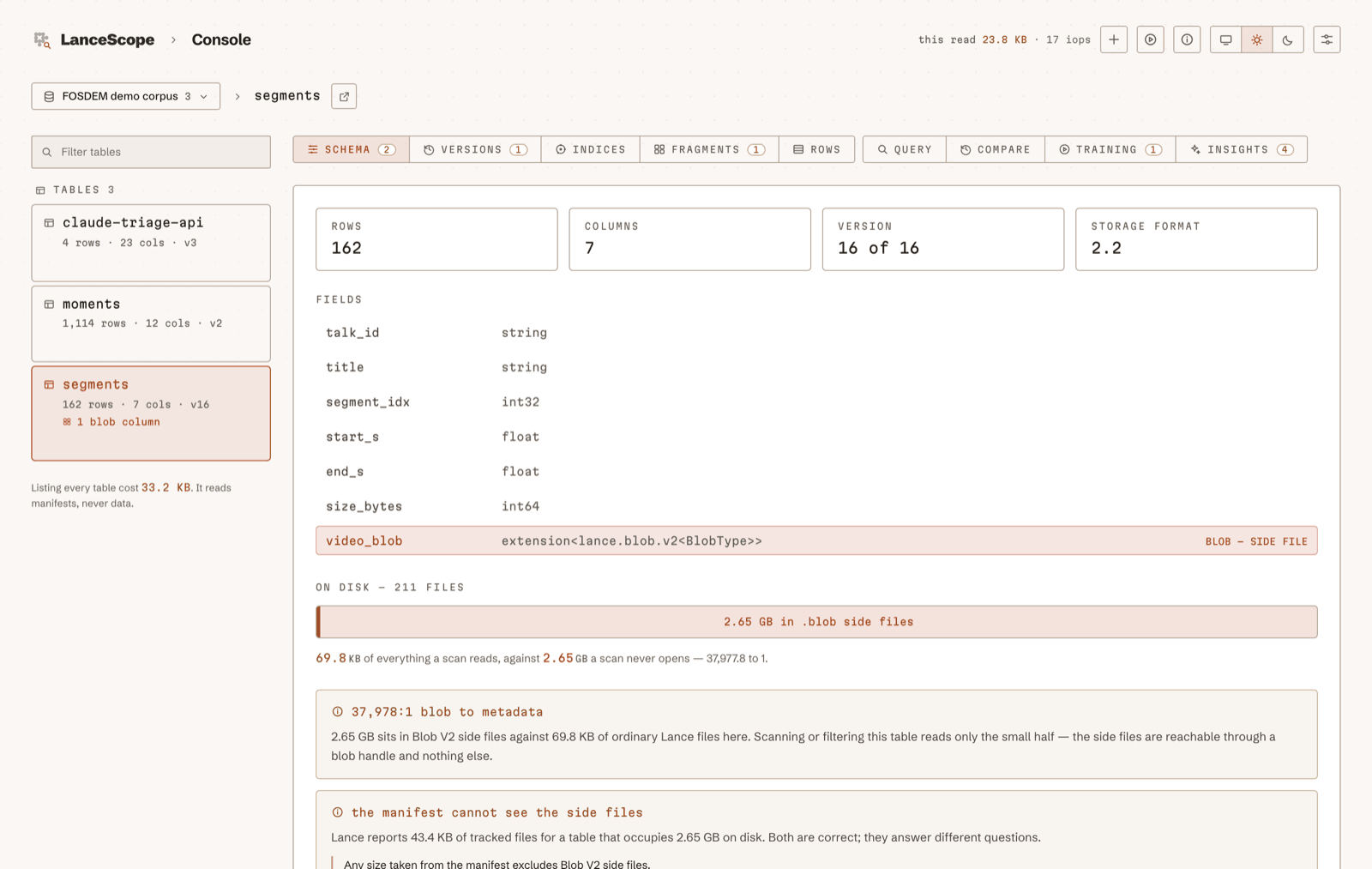
A Lance table can hold 2.65 GB of video while a search over it reads none of it. The bytes a search touches and the bytes a table holds live in different files, and almost nothing shows you both. This does — and then it says what it already knows: ten rules over metadata, each carrying the numbers it was derived from. No model is asked, so nothing there costs a token.
Website · Live console · Docs · Repo
Python 3.12 · FastAPI · Next.js 16 · 8 pinned Lance readers on ghcr.io · 8 read-only MCP tools · a signed macOS app
Learn the Claude API by building a real support-triage service — structured outputs, tool use, streaming, prompt caching, and evals. Eleven labs, a Python track, an instructor kit, and a storefront where your own words get classified live.
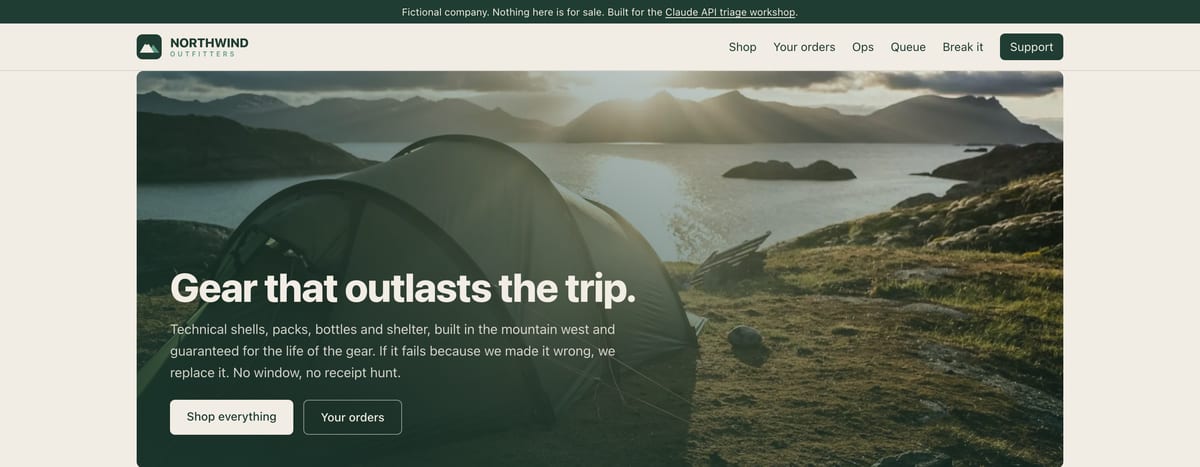 The shop. File a ticket and watch it get triaged, then try to break the classifier.
|
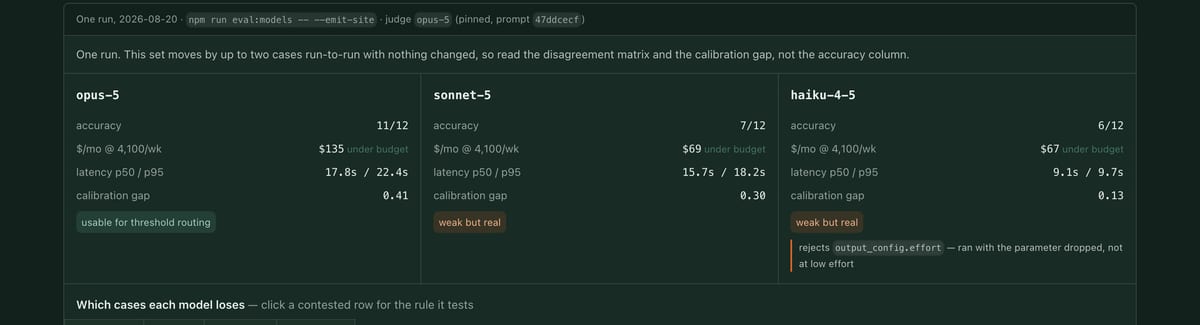 The playgrounds. Seven of them, rendering real runs rather than illustrations of runs.
|
Four routes, four capabilities, one coherent domain — each route introducing exactly one new idea and building on the one before it. The scenario is a company with 4,100 support tickets a week and an incident where a child's injury report sat unrouted for three days because it opened with "probably nothing." Every design decision traces back to that page.
Day 1 is about four hours and leaves you with a service you can show. Day 2 is for people who are going to ship: which model, what happens when the input is hostile, and what separates a demo from a service.
Take the course · Visit the shop · Watch the intro · Repo
TypeScript · FastAPI (Python track) · Next.js · Docusaurus · an eval harness with deterministic scoring and an LLM judge
End-to-end RAG pipelines on Voyage AI embeddings and MongoDB Atlas Vector Search. One command takes a directory of documents to a searchable vector database:
npm i -g voyageai-cli
vai pipeline ./docs/
Five chunking strategies, two-stage retrieval (embed → vector search → rerank), eight benchmark subcommands covering latency, cost, asymmetric retrieval and quantization, and an interactive playground for the parts that are easier to see than to read about.
vaicli.com · Docs · npm · Repo
Community tool — not an official MongoDB or Voyage AI product.
| NetPad | Agentic workflow diagramming and builder |
| MermaidGPT | Mermaid diagrams from a sentence |
| AI Project Mapper | LLM-friendly project summaries, so an assistant can understand a codebase it has not read |
| mongodb-erd | Entity-relationship diagrams inferred from a live MongoDB database |
| MongoDB-RAG | Similarity search, caching and retrieval as a library |
| MacFaceSwap | Face swapping on a Mac, because someone asked |
200+ talks, 50K+ developers, and a strong preference for the kind where everyone opens a terminal. AWS re:Invent — a lightning talk on the evolution of data to intelligence. MongoDB Developer Days — hands-on training, run worldwide. The MongoDB Podcast — co-host, on AI, developer tools, and databases.
If you have something to build or want to dig into a collaboration: book a time →