DeployProof is a Python CLI tool for AI-code verification — it catches what 100% line coverage misses by running in-memory AST mutation testing on your git diff before any commit reaches CI. Created by SVS Praveen.
pip install deployproof






📖 View the Complete Interactive Product Portal & Live Docs
💡 Curious why we built it this way? Read our architectural rationale in DECISIONS.md.
- Why This Exists
- How It Compares: DeployProof vs. Mutmut vs. Cosmic Ray
- Installation
- Quickstart & Walkthrough
- How It Works
- The Verification Gates
- CI/CD & Pre-Commit Integration
- Configuration (
pyproject.toml) - Full Documentation & CLI Reference
The standard AI-code workflow produces tests that pass CI but don't actually verify anything. A test suite at 90% line coverage can have a mutation score near zero — meaning almost any change to the logic under test goes completely undetected.
DeployProof runs in-memory AST mutation testing scoped to your git diff. It mutates operators, constants, and control-flow in warm RAM (no disk writes), runs your tests against each mutant, and fails the push if surviving mutants exceed your threshold — in the time it takes to read a Slack message.
It also ships with a set of companion security gates for the failure modes that mutation testing doesn't catch on its own: hardcoded secrets, OWASP-class SAST patterns, hallucinated dependencies, and symlink escapes.
Privacy guarantee: DeployProof runs 100% locally. The only outbound requests are read-only: PyPI JSON API (dependency hallucination check) and OSV (CVE lookup, opt-out with
--no-check-cve). No source code, test results, or findings leave your machine.
The core difference from mutmut and Cosmic Ray is where the mutation happens. Both of those tools rewrite source files on disk and spawn a fresh test process for every mutant — which is slow and doesn't scope to your diff. DeployProof compiles all mutants into a single conditional AST in warm RAM and only tests the files you actually changed:
| DeployProof | mutmut | Cosmic Ray | |
|---|---|---|---|
| Mutation engine | In-memory AST schemata | File rewrite to disk | AST disk rewriting |
| Scoped to git diff | Yes | No (full repo) | No (full repo) |
| Self-healing test synthesis | Yes | No | No |
| Async/await, arg-swap, boundary mutations | Yes | Partial | Partial |
| Secrets & SAST scanning | Also included | No | No |
| Dependency hallucination & CVE checks | Also included | No | No |
| Multi-worker sandboxes | Yes (--workers N) |
No | Distributed (Celery) |
| GitHub Actions summaries | Yes | No | No |
pip install deployproof

# Recommended: isolated environment with global CLI access
pipx install deployproof
Requires Python 3.10+ (macOS, Linux, Windows).
| Command | Action | Impact |
|---|---|---|
deployproof check |
Diff Pre-Push Gate | In-memory AST mutation on modified files in warm RAM |
deployproof check --heal-tests |
Self-Healing Synthesizer | Auto-generates ready-to-run pytest cases to kill surviving mutants |
deployproof check --full-repo --workers 8 |
Full Repo Sweep | Exhaustive whole-codebase scan with parallel worker sandboxes |
deployproof check --wsl |
Windows WSL Acceleration | Delegates mutation testing to native Linux kernel for speed |
deployproof init |
1-Click Pre-Push Hook | Installs .git/hooks/pre-push to guard every push automatically |
deployproof check --json |
CI / IDE Stream | Emits clean structured JSON for custom tooling |
Given a newly written function calculator.py:
def calculate_discount(price: float, rate: float) -> float:
    if rate > 0.5:
        return price * 0.5
    return price * (1.0 - rate)
With an AI-generated test that achieves 100% line coverage by only asserting a single happy path (rate = 0.2):
def test_calculate_discount_basic():
    assert calculate_discount(100.0, 0.2) == 80.0
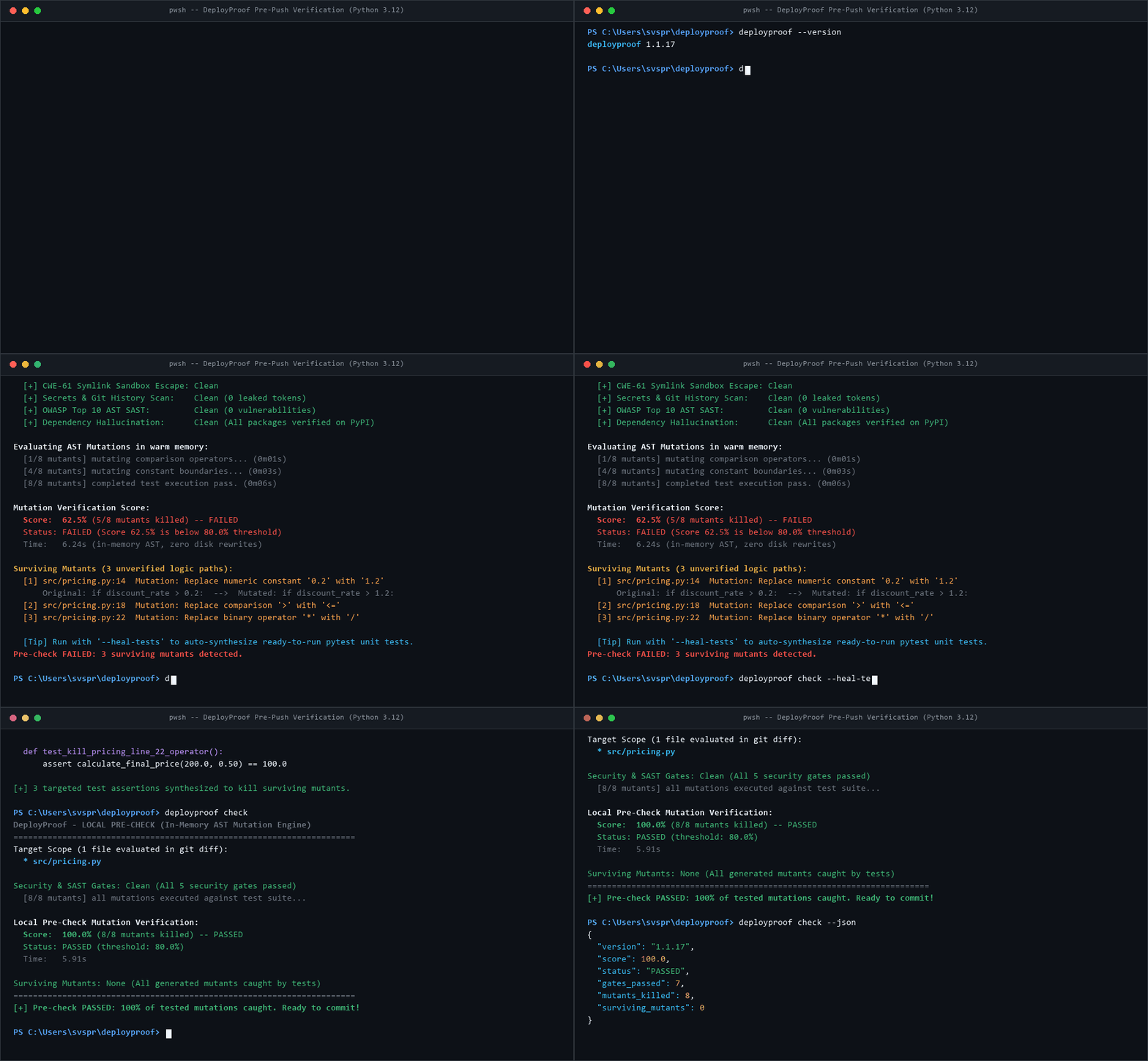
Running deployproof check mutates AST operators in memory and immediately exposes that threshold caps and boundaries are unverified:
$ deployproof check

Target Scope (1 file evaluated):
  * calculator.py

Local Pre-Check Mutation Verification:
  Score:  57.1% (4/7 mutants killed)
  Status: FAILED (score 57.1% below 80.0%)
  Time:   2.27s

Surviving Mutants (3 unverified changes):
  [1] calculator.py:2  Mutation: Replace numeric constant '0.5' with '1.5'
  [2] calculator.py:3  Mutation: Replace numeric constant '0.5' with '1.5'
  [3] calculator.py:3  Mutation: Replace binary operator '*' with '/'

Pre-check FAILED: Score 57.1% is below threshold 80.0% (3 surviving mutants).
Run with --heal-tests (or interactively with -i) to automatically synthesize ready-to-run pytest unit tests that target the exact surviving mutants:
deployproof check --heal-tests# Generated in tests/test_deployproof_healed.py
def test_calculate_discount_boundary_rate():
assert calculate_discount(100.0, 0.5) == 50.0
def test_calculate_discount_capped_rate():
assert calculate_discount(100.0, 0.8) == 50.0Re-running deployproof check immediately passes:
Local Pre-Check Mutation Verification:
  Score:  100.0% (7/7 mutants killed)
  Status: PASSED (threshold: 80.0%)
  Time:   2.31s

Surviving Mutants: None (All generated mutants caught by test suite)
Pre-check clean: 100% of tested basic mutations caught.
DeployProof runs in two modes:
Evaluates only the files modified in your git diff. Because mutants are compiled into warm RAM — no disk writes, no file copies — this mode is significantly faster than traditional mutation tools and completes before your attention switches context.
# Check modified files in your current git diff
deployproof check

# Output structured JSON for IDE tooling or custom pipelines
deployproof check --json

# Enforce strict gates on newly introduced mocks or swallowed errors
deployproof check --strict-mocks --strict-error-handlingEvaluates every tracked Python file across the entire repository, parallelizing across isolated worker sandboxes:
deployproof check --full-repo --workers 8Translates Windows paths (safely quoting spaces), delegates mutation runs to mutmut inside a native Linux environment in WSL, and streams results back to your Windows console:
deployproof check --wsl⚙️ One-Time WSL Setup:
wsl bash -c "python3 -m venv ~/.deployproof-wsl-venv && ~/.deployproof-wsl-venv/bin/pip install mutmut pytest"
(If WSL is not configured, DeployProof falls back to the native in-memory engine with a notice.)
Gate 1 — In-Memory AST Mutation Engine
Mutates operators (>=, ==, and, or, *), numeric constants, string boundaries, async/await drops, and argument swaps. All mutants are compiled into a single conditional AST and toggled via environment variable — no disk I/O, no file copies.
Gate 2 — Self-Healing Test Synthesizer
Analyzes surviving mutants and synthesizes ready-to-run pytest unit tests with inferred parameter signatures, class method instantiation, and boundary value fixtures. Run with --heal-tests or -i for interactive mode.
These run alongside the mutation pass and catch categories of failure that mutation testing alone doesn't cover:
Gate 3 — AST OWASP Top 10 SAST Scanner
Zero-dependency static scanner: SQL injection, shell=True, os.system, insecure deserialization (pickle, yaml.load), path traversals, disabled SSL.
Gate 4 — Secrets & Git History Scanner
Shannon entropy scan of session files and the past 50 git commits: OpenAI, Anthropic, AWS, GitHub, and Stripe keys.
Gate 5 — Dependency CVE & Slopsquatting Defense
Cross-references requirements against OSV for known CVEs; queries PyPI JSON API in real time to catch hallucinated package names.
Gate 6 — CWE-61 Symlink Sandbox Escape
Resolves symlinks and blocks any whose target falls outside the repository root.
Gate 7 — Control Flow & Error Handling
Detects bare except:, swallowed exceptions, unreachable dead code, and mock leaks (--strict-mocks, --strict-error-handling).
Curious why in-memory AST schemata instead of file rewrites, or how the dual-tier model works?
👉 Read DECISIONS.md for the complete technical design document, performance trade-off analyses, and threat models.
name: DeployProof Gate
on: [push, pull_request]

jobs:
  verify:
    runs-on: ubuntu-latest
    steps:
      - uses: actions/checkout@v4
        with:
          fetch-depth: 50
      - uses: actions/setup-python@v5
        with:
          python-version: '3.12'
      - run: pip install -e . && pip install deployproof pytest
- run: deployproof check --github-actions --workers 4repos:
- repo: https://github.com/SVSPraveen/deployproof
rev: v1.1.19
hooks:
- id: deployproof-check[tool.deployproof]
threshold = 85.0
workers = 8
timeout = 15.0
strict_mocks = true
strict_error_handling = true
sast_scanning = true
history_secrets_scanning = true
cve_scanning = true
generate_tests = "tests/test_deployproof_healed.py"For exhaustive CLI flag references, JSON output schemas, and advanced customization:
👉 Explore the Interactive DeployProof Portal & Docs Site
Issues and pull requests are welcome. Open an issue first for significant changes so the approach can be discussed before implementation.
MIT. See LICENSE.
DeployProof is created & architected by SVS Praveen — Python developer focused on AI-code verification tooling · Portfolio · LinkedIn